


- News
AIRoA Releases “AIRoA-0” Robot Foundation Model
2026-11-06


Learning bimanual tasks, including parts sorting and towel folding, from 16,151 hours of manipulation data collected without robots
AIRoA has released its robot foundation model, “AIRoA-0 (hereafter “A-0”, *1)”. A-0 integrates data processing, pre-training, post-training, and action generation on physical robots to enable them to learn manipulation motions recorded by humans using the data-collection device “YUBI (Yielding Universal Bidigital Interface, *2)” .
AIRoA tested the model at a site different from the environments where the manipulation data used for training had been collected, confirming its ability to perform bimanual tasks such as sorting small parts and folding towels. Furthermore, we verified its ability to respond when humans alter an object’s position during a task, as well as its operation on four robot types currently available at AIRoA. Across the ten evaluation tasks, A-0 achieved an average success rate of 78%, compared to 27% for the strongest of four other vision-language-action models post-trained on the same data.
AIRoA has released both pre- and post-trained model weights, together with related code. Technical details and evaluation results are available in the technical report. The released model and code are available for use in research and development. AIRoA will use insights and feedback from their use to inform future development.
#These results were obtained through the commissioned project “Project for Strengthening Post-5G Information and Communication Systems Infrastructure / Development of a Data Platform for Generative AI Foundation Models in the Robotics Field,” (Project No. JPNP25015) promoted by Japan’s Ministry of Economy, Trade and Industry (METI) and the New Energy and Industrial Technology Development Organization (NEDO).
Background
Teaching robots to perform a wide range of tasks requires diverse manipulation data. AIRoA believes that enabling people to record manipulation data in different locations, without needing a robot for data collection, is the key to scaling robot learning.
YUBI is a device that records video and gripper trajectories as a person operates handheld grippers. Starting from the π0.5 base weights released by Physical Intelligence, AIRoA used 16,151 hours of YUBI-collected data. In this manipulation training, AIRoA did not collect data through robot teleoperation, use reinforcement learning, or perform on-robot corrections.
Key Features and Results
Performing Precise and Multi-Step Tasks
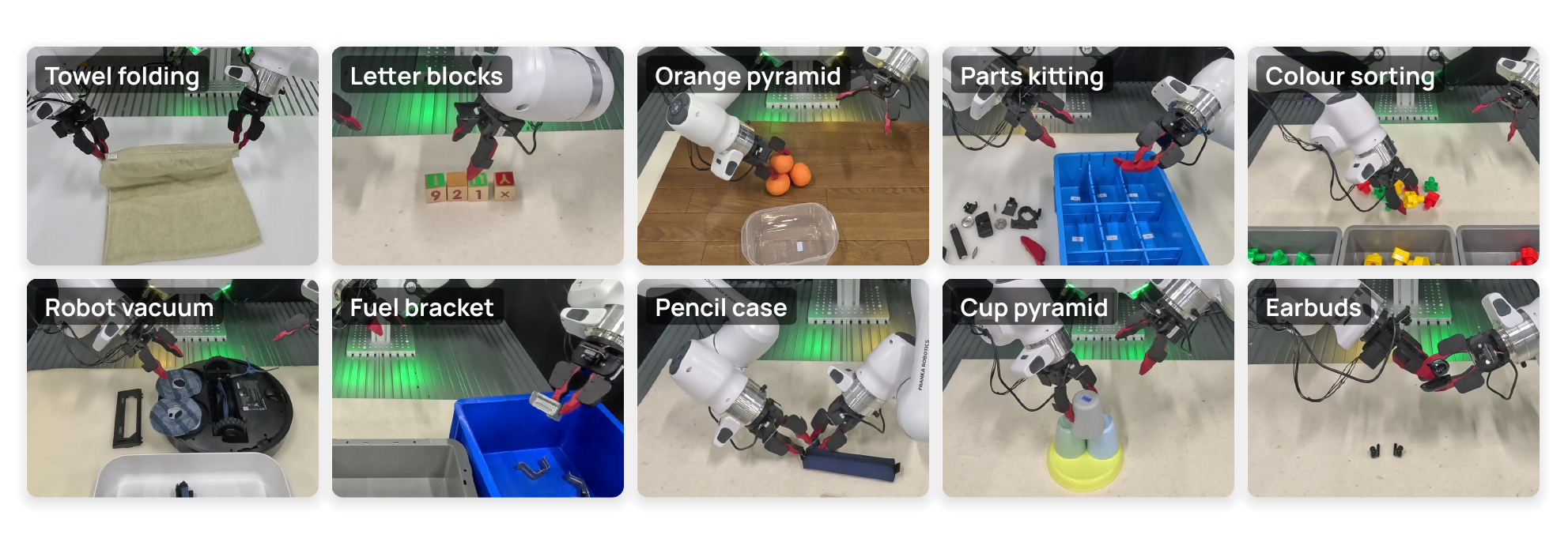
At a site where none of the training data had been recorded, the robot executed tasks using images from the wrist cameras on YUBI devices mounted to its left and right wrists. A-0 sorted more than a dozen small parts into numbered cells from a single instruction. It also performed tasks such as unzipping a pencil case, filling it with pencils, and then zipping it shut.
For evaluation, 10 types of tasks—including towel folding, replacing parts of a robot vacuum cleaner, and stacking cups or oranges—were tested 15 times each, achieving an average success rate of 78%.
Capturing Task-Critical Information and Adapting to Layout Changes
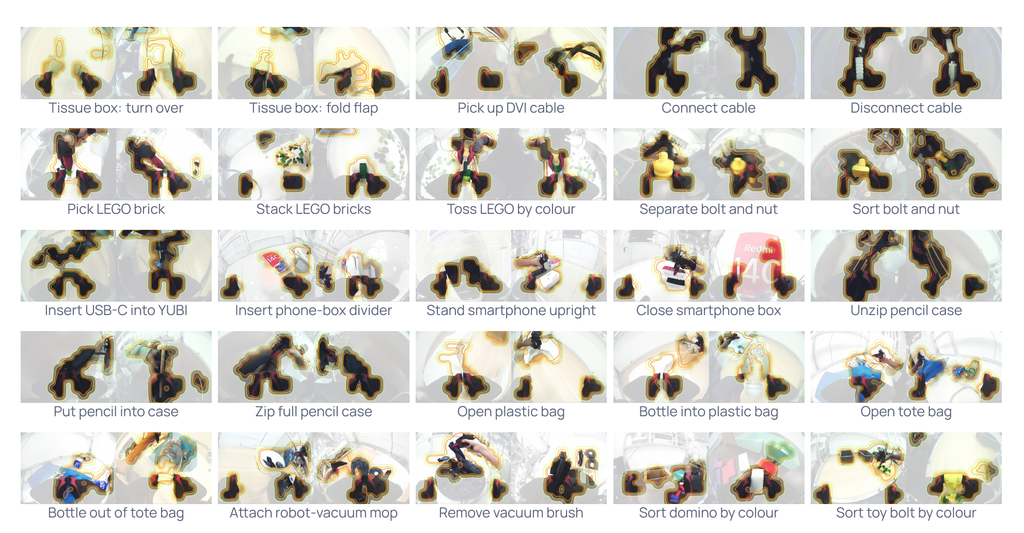
In an experiment involving color-based parts sorting, we confirmed that even when a person moved the sorting box midway through the task, the robot adjusted its motion to place the parts into the relocated box. A-0 is a vision-language-action (VLA) model that learns the visual information essential for tasks without requiring human annotations to identify key regions in an image. Furthermore, it combines mechanisms to track past states and the current task stage with streaming action generation.
Deploying the Same Model on Any Robot Equipped with YUBI
A-0 outputs gripper poses (position and orientation) rather than robot-specific joint angles. The control system of each robot platform then translates these outputs into actual arm motions. With this architecture, as long as the YUBI gripper is attached, the same model can be utilized across different robot platforms regardless of the underlying hardware. To date, we have confirmed operations on four dual-arm platforms: Franka, TX-G2, OpenArm, and UR.
Details of the evaluation conditions and results for each robot platform and task, as well as in-depth technical descriptions, are provided in the technical report.
Technical Report : https://arxiv.org/abs/2611.03815
A-0 project page:https://a-0.airoa.io
Released Resources and How to Use Them
To enable researchers and developers to post-train the model for their own use cases and validate it on physical robots, the following assets have been publicly released:
| Resource | Contents | Location |
| Data collection code | Code for collecting data using YUBI | https://github.com/airoa-org/yubi-go |
| Model weights | Pre-trained model and post-trained models for the evaluation tasks | https://huggingface.co/airoa-org/AIRoA-0 |
| Post-training code | Code for post-training on your own data (under four hours on a single node of eight GPUs). | https://github.com/airoa-org/AIRoA-0 |
| Inference code | Example code that takes sensor data and other inputs to output gripper poses (position and orientation) | https://github.com/airoa-org/openarm-pipeline |
※The release scope of each codebase, as well as supported robot platforms and runtime environments, will be detailed on the release page.
AIRoA also plans to release the dataset used for training. Details, including the release timing, scope, and instructions for use, will be announced on the AIRoA website once finalized.
YUBI’s hardware designs and data collection software are already publicly available. For details, please visit: YUBI website
Inquiries
- Inquiries about use and evaluation:
ext-oss@airoa.org - Inquiries about research collaboration:
collaboration@airoa.org
AIRoA at CoRL 2026
AIRoA will present this research and other related initiatives at Booth 210 at CoRL 2026, which will be taking place between November 9–12, 2026, in Austin, Texas, USA.
※1 AIRoA-0 (A-0)
AIRoA-0 (A-0) is a robot foundation model developed by the AI Robot Association (AIRoA). It learns from manipulation data recorded by people using the YUBI handheld gripper, without robots needed for data collection, and performs bimanual tasks. A-0 integrates data processing, pre-training, post-training, and action generation on physical robots, and has been tested on different robot platforms equipped with YUBI. Pre-trained and post-trained model weights and related code are publicly available for use in research and development.
※2 Open-Source Data Collection Device “YUBI”
YUBI (Yielding Universal Bidigital Interface) is a data collection interface designed for bimanual dexterous manipulation that records video feeds and hand trajectories during human object manipulation.
By combining a gripper mechanism designed to conform to human finger movements with VR-based pose tracking, it enables the collection of diverse manipulation data without relying on physical robot bodies.
Both the hardware design (Toyota Motor Corporation Frontier Research Center) and the data collection software (AIRoA) are open-sourced, allowing researchers and developers to replicate and extend the data collection setup.